Can AI create a balanced dog food recipe? We tested one – here’s where it fell short.
We tested a ChatGPT chicken-and-brown-rice recipe with WoofChef to see whether it met NRC adult-maintenance nutrient minimums.

AI tools like ChatGPT, Claude and Gemini can produce a dog food recipe in seconds. The recipes can sound plausible, but can you trust them? We asked ChatGPT for one and checked what it gave us.
What does “balanced” mean?
Canine nutrition science studies how dogs use food and how their diets can support a healthy life. Dogs vary enormously in size, build, activity and health, so choosing a diet means considering the individual dog.
Researchers work out which nutrients dogs need, in what amounts and proportions, and how those needs change through life. We often bundle all of that into the word “balanced.” A complete diet supplies all the required nutrients; a balanced diet supplies them in appropriate amounts and proportions for its intended life stage.1 It also needs to provide suitable calories and stay below harmful nutrient levels. A bowl can contain plenty of protein and calories while falling short on vitamins, minerals or essential fats.
WoofChef compares recipes with the adult-maintenance recommendations in the National Research Council's 2006 report.2 These apply to healthy adult dogs maintaining their weight. For this example, we used the NRC metabolic-weight comparison, which scales nutrient needs to the dog's body weight raised to the power of 0.75. You can read more about how WoofChef performs this comparison.
When WoofChef says a recipe Meets NRC Minimums, the available data supports every applicable minimum in that comparison, and the analysis found no known safety-limit excess.
Choosing a diet still depends on the dog's age, health, body condition, activity, other food and willingness to eat it. WSAVA's nutritional-assessment guidance considers the animal, the diet and how it is fed together.3
For a long-term homemade diet, a veterinarian or veterinary nutritionist should formulate or review the plan for the individual dog.
Checking the numbers helps reveal nutrient shortfalls, unsafe excesses and missing information in a recipe that otherwise sounds reasonable.
Here's what we found when we checked ChatGPT's recipe using publicly available food data and the NRC recommendations.
The ChatGPT example recipe
We asked ChatGPT:
Our prompt
Generate a balanced recipe for my 30lb adult dog. He is at his ideal weight, neutered, and takes 3 walks a day. Include chicken and brown rice in the recipe, and then whatever other ingredients you suggest he needs. Make it a 1 day batch.
ChatGPT began with an appropriate warning. It said that a veterinary nutritionist should formulate a long-term homemade diet because chicken, rice, and vegetables can miss calcium, essential fatty acids, vitamins, and trace minerals. It estimated the dog's starting energy need at roughly 650–750 kcal per day.
It suggested:
1-day chicken & brown-rice batch
- 6 oz cooked, skinless chicken breast, chopped
- 1 cup cooked brown rice
- ½ cup cooked sweet potato, mashed
- ½ cup cooked green beans, chopped
- ¼ cup cooked carrots, chopped
- 1 tsp fish oil providing an appropriate amount of EPA+DHA
- Calcium supplement formulated for dogs, dosed according to the product's veterinary directions
- A complete canine vitamin/mineral supplement specifically intended to balance homemade diets, used according to its label
Making the recipe precise enough to analyze
First, we needed gram weights for the food and enough detail to calculate what each supplement would contribute.
We selected the cooked, unsalted food entries in WoofChef's reviewed catalog and used USDA FoodData Central portion weights to convert the household measures into grams:4
- 170.1 g cooked, skinless chicken breast
- 202 g cooked brown rice
- 100 g cooked sweet potato
- 62.5 g cooked green beans
- 39 g cooked carrots
This gives us a 573.6 g food portion.
We left the fish oil, calcium supplement and vitamin/mineral supplement out of the initial analysis because we couldn't calculate their contributions. The fish oil's EPA and DHA content varies by product, and “an appropriate amount” leaves the dose open. The other two supplements had neither a product name nor an amount.
Our results therefore describe the food portion. They show the gaps a supplement plan would need to address; the complete recipe remains uncertain until those supplements are specified.
Estimating the dog's daily calories
Thirty pounds is 13.61 kg. We chose WoofChef's typical adult activity setting for this example. “Three walks a day” leaves their length and pace unclear, so this was an assumption.
WoofChef's typical-adult starting estimate is:
110 kcal × body weight in kilograms^0.75
For this dog, that gives a starting estimate of 779.4 kcal per day. Guided works within a range of about 717–842 kcal. Actual calorie needs vary, so feeding amounts should be adjusted with the dog's weight trend and body condition in mind.5
What WoofChef found
The food portion provides 654.65 kcal, before adding any fish oil or supplements. That falls within ChatGPT's 650–750 kcal estimate and below the range we used in Guided.
The food portion also fell below several NRC minimums used in this analysis.6
For the nutrients below, all five food entries had accepted data:
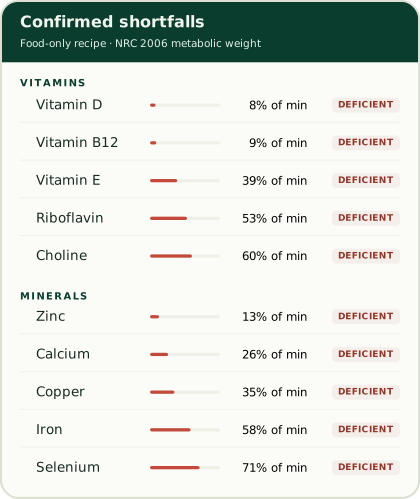
Fat reached about 91% of its minimum comparison, and phosphorus reached about 96%. The calcium-to-phosphorus ratio was 0.16:1, below the NRC adult-maintenance range of 1:1 to 2:1 used in this analysis.2
The food portion had no known safety-limit excess, but it still lacked enough of several nutrients.
What was missing from the supplement plan?
ChatGPT's warning was sensible. Its supplement instructions, though, left us with more work to do before we could check the full day's food.
It did not say:
- which nutrients the food portion was low in;
- which exact supplement products would close those gaps;
- how much of each active nutrient the dog would receive;
- whether the supplements would overlap;
- whether the final calcium-to-phosphorus ratio would be appropriate; or
- whether the completed recipe would remain below applicable safety limits.
To check the finished recipe, we'd need the products, their label information and their doses, then calculate their contributions alongside the food.
Can WoofChef make the same idea meet NRC minimums?
Next, we used WoofChef's Guided mode with the same five foods: chicken breast, brown rice, sweet potato, green beans and carrots. Guided could adjust their amounts and add foods, oils and specific nutrient doses from its reviewed options.
Guided changed the quantities and added several ingredients. This example shows the amounts used in the calculation. All food weights are measured after the preparation described below.4
- 275 g chicken breast, meat only, cooked, roasted
- 85 g brown rice, long-grain, cooked
- 115 g sweet potato, baked in skin, flesh only, without salt
- 93.5 g green beans, boiled, drained, no salt
- 82.8 g carrot, boiled, drained, no salt
- 23.3 g beef liver, cooked, pan-fried
- 93.5 g broccoli, cooked, boiled, drained, without salt
- 2.2 g finely ground eggshell powder, using the app's reviewed composition
- 3.7 g iodized salt, using the app's reviewed composition
- 3.3 g NOW Wheat Germ Oil Liquid7
- 1 g standard fish oil at the app's 18% EPA / 12% DHA benchmark
- 8.5 mg elemental zinc
- 77 IU vitamin D3
The revised recipe provided 834.3 kcal, within the 717–842 kcal range. WoofChef rechecked these amounts and returned Meets NRC Minimums, with no known safety-limit excess and no unresolved minimum shortfall in that run.6
Some uncertainty remained. The estimated ratio of linoleic acid to alpha-linolenic acid was 9.14:1, based on incomplete source data.
The zinc and vitamin D3 amounts refer to the nutrients themselves. The calculation counts those doses only; product quantities would depend on the chosen labels. The fish oil would need to match the stated EPA and DHA content.
This example illustrates the calculation process. It would still need professional review before being used as a feeding plan for an individual dog.
The useful part of the AI answer was its warning
ChatGPT warned that chicken, rice and vegetables could leave nutrient gaps and recommended professional formulation. That was useful advice.
The recipe left the hard part unfinished. It gave us a food base and vague supplement instructions, without showing whether the complete day's food would meet the dog's needs.
This was one ChatGPT answer. It tells us what was missing from this example, without settling what every AI tool could do. An AI system connected to reliable food data and a calculation engine could check its recipes. For the answer we received, those calculations were still ours to do.
Sources and references
Footnotes
-
Association of American Feed Control Officials. “Selecting the Right Pet Food.” AAFCO defines “complete” as containing all required nutrients and “balanced” as providing those nutrients in the correct ratios for the intended life stage. Read AAFCO's explanation. ↩
-
National Research Council. Nutrient Requirements of Dogs and Cats. National Academies Press, 2006. Read the consensus report. ↩ ↩2
-
World Small Animal Veterinary Association Global Nutrition Committee. Nutritional Assessment Guidelines, 2011. Read the guidelines. ↩
-
U.S. Department of Agriculture, FoodData Central, SR Legacy records: 171477, chicken breast, cooked, roasted; 169704, brown rice, long-grain, cooked; 168483, sweet potato, cooked, baked in skin, flesh, without salt; 169141, green beans, cooked, boiled, drained, without salt; 170394, carrots, cooked, boiled, drained, without salt; 168627, beef liver, cooked, pan-fried; and 169967, broccoli, cooked, boiled, drained, without salt. ↩ ↩2
-
American Animal Hospital Association. “Feeding Plans for Healthy, Appropriate Weight Cats and Dogs,” 2021. Read the AAHA guidance. ↩
-
WoofChef Analyzer and Guided formulation rerun locally September 12, 2026, using the exact inputs stated in this article, the NRC metabolic-weight basis, a 30 lb (13.6078 kg) dog, local
local_core_v1, catalogwoofchef-core-v1:d4a926e8276b58b9831272ab46c80846ce710953223cb4b687f93cce743bcb39, and the current Guided formulation-module registry. This records the local reproduction; the generic WoofChef recipe checker does not preserve a replayable run. ↩ ↩2 -
NOW Foods, Wheat Germ Oil Liquid. WoofChef's named module uses this liquid product as its exact-product benchmark and normalizes its label composition to the per-100 g profile used by the Analyzer. ↩
About this article's scope
All articles are posted for educational content only. WoofChef does not diagnose, treat, prescribe, approve a diet, or replace a veterinarian or veterinary nutritionist.
WoofChef is a planning and analysis tool for healthy adult dogs on maintenance diets only. It is not for puppies, pregnant or nursing dogs, or dogs that need a therapeutic diet. Any change to your dog's diet should be reviewed and approved by a qualified veterinary professional.
Check the recipe itself.
Articles can explain the reasoning. The analyzer shows what a real ingredient list does against the supported NRC basis.